
Multi-Protocol KNX Residential Supervision
Real-world residential Building Automation system with KNX as the field level and openHAB as the central platform for supervision, automation and multi-protocol integration.
The project coordinates lighting, shading, temperature control, scenarios, energy monitoring, IP devices, notifications and diagnostics, while keeping the essential functions of the installation independent from the software supervision layer.
System Developed
The project was developed as a multi-protocol supervision platform designed to coordinate devices, services and logic belonging to different ecosystems without replacing the installation’s primary automation layer.
Centralised Supervision
Centralised control of the main residential functions through interfaces organised by floor, room and function, with consistent visualisation of commands, states and feedback.
Multi-Protocol Integration
Integration of KNX, IP devices, weather services, photovoltaic systems, smart devices, voice assistant and notification systems within a single supervision platform.
Context-Aware Automation
Development of scenarios, operating conditions, interlocks and logic based on the actual states of the installation, avoiding assumptions about system behaviour based solely on the command sent.
Live Operational System
A real system in active operation, monitored through logs and notifications and progressively updated while maintaining operational continuity and separation between essential functions and the supervision layer.
Solution Architecture
The solution is organised across multiple layers: KNX devices and actuators at field level, KNX/IP interface, openHAB supervision, software logic, virtual Items, data persistence and integrations with external devices and services.
The separation between the field layer and supervision keeps the essential functions of the installation operational even when the supervisor is unavailable, while the software layer adds interfaces, advanced automation, historical data, notifications, diagnostics and multi-protocol integration.
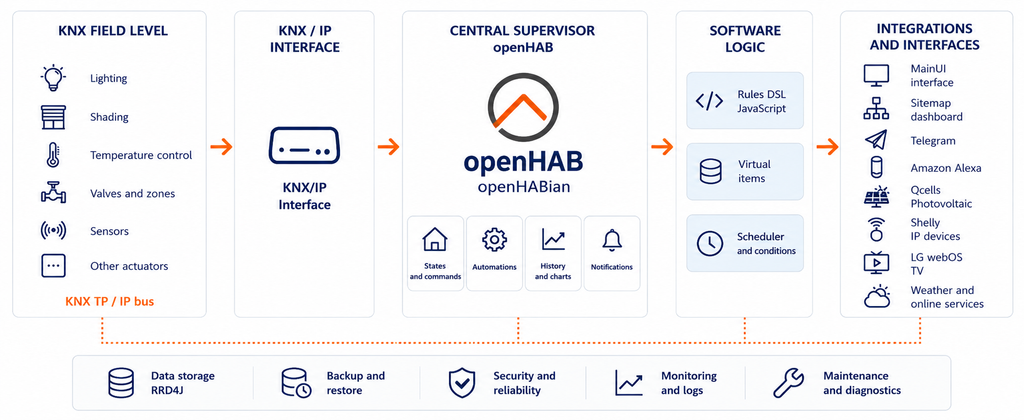
The separation between KNX field devices, openHAB supervision, software logic, persistence and IP integrations keeps the system structured, verifiable, maintainable and expandable over time.
Main Automations
The automations were developed to coordinate distributed functions, reduce repetitive operations and, where available, use the actual states of the installation as the reference for logic behaviour.
Home Scenarios
Management of scenarios such as arrival, departure, night mode and daily routines, with coordinated sequences involving lighting, shading and selected loads.
Privacy & Shading
Dedicated logic for managing shutters and shading systems, with predefined positions, operating conditions and controlled reopening to prevent unintended movements.
Cinema Mode
Coordination between TV, lighting and shutters to automatically adapt the environment for viewing and restore the expected state when the mode ends.
Outdoor Lighting
Automatic management of outdoor and pathway lighting according to sunrise, sunset and configurable offsets.
Valve Exercise
Controlled periodic opening and closing cycle for thermohydraulic valves to reduce the risk of sticking after long periods of inactivity.
Voice Commands
Controlled exposure of selected scenes and functions through a voice assistant, while keeping the main logic and state management within the local supervisor.
Energy Monitoring
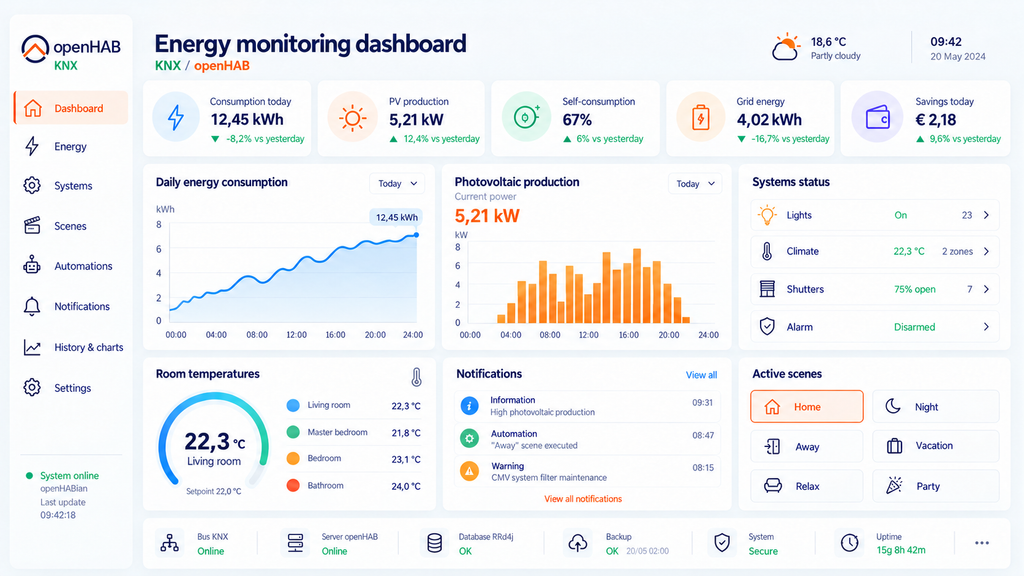
The system acquires and organises available energy data from the photovoltaic system, inverter and batteries, integrating them into the supervision platform for visualisation, historical recording and use within monitoring logic.
Production & Consumption
Visualisation of instantaneous production, household consumption, power exchanged with the grid and aggregated energy values.
Batteries
Monitoring of state of charge, charging or discharging power and technical parameters made available by the energy storage system.
Historical Data
Selective persistence of useful values for comparing production, consumption, grid export and overall energy behaviour over time.
Energy Supervision
Organisation of the main energy data within a dedicated view, accessible from local and mobile interfaces for consultation and operational verification.
Diagnostics, Notifications & Troubleshooting
The system is monitored through application logs and operational notifications, with dedicated management of errors, warnings and significant events. This structure makes it possible to identify anomalies, logic errors, unreachable devices and integration issues more quickly.
Operational Notifications
Notifications are sent for relevant events, anomalies, state changes and information useful for the operational management of the system.
TV Notifications
Informational messages are displayed on interfaces available within the residence, presenting only the operational information required by the user.
Diagnostic Logs
Errors, warnings and relevant events are tracked using structured messages, making it easier to identify the source of problems and verify system logic.
Troubleshooting
The structure makes it possible to distinguish more quickly between issues related to the KNX bus, bindings, rules, feedback, IP devices or platform configuration.
Technical Solutions Adopted
The technical value of the solution lies in the separation between primary automation, supervision, software logic, virtual Items, actual feedback, selective persistence and diagnostics. Where available, automations use the actual states of the installation rather than assuming that a command has been executed.
KNX as the Field Layer
Essential functions remain assigned to the KNX bus, keeping the installation operational even if the supervisor or additional software services are unavailable.
openHAB as Supervisor
openHAB coordinates supervision, states, advanced automations, interfaces, energy data, notifications and IP integrations without replacing the underlying KNX layer.
Virtual Items
Scenes, voice commands and software functions operate through intermediate virtual objects, separating the user interface from internal logic and simplifying future modifications.
Actual Feedback
Where available, interfaces and automations use the actual states of the installation, reducing discrepancies between the command sent, the expected state and the actual state.
Selective Persistence
Only data useful for diagnostics, energy monitoring and analysis is stored, avoiding unnecessary writes and uncontrolled database growth.
Modular Configuration
Things, Items, rules, persistence and interfaces remain separated to simplify debugging, updates, maintenance and future expansion.
Technologies Involved
Technologies & Platforms
Integrated Functions & Services
Final Result
The result is a single multi-protocol supervision platform that coordinates technologies originally operating separately, while maintaining the operational autonomy of the KNX bus, consistent control from local and mobile interfaces, advanced automations, energy monitoring and remote diagnostics.
The software structure remains modular, documentable and expandable, allowing the integration of devices, services and new functions without tying the entire system to a single ecosystem.
Do you have a KNX or Building Automation project that needs integration or expansion?
I can support you with system design, programming, supervision, System Integration, commissioning and troubleshooting of KNX and Building Automation systems, either for a specific project phase or by working alongside your team during technical development.